Where Wisconsin Cities Get Drinking Water: Full Overview
Wisconsin cities do not all draw drinking water from the same place. A tap may be supplied by groundwater, surface water, or a combination, and the source can affect treatment and the information a utility reports. If you are trying to identify where your city’s water begins, the most reliable starting point is your utility’s water quality report, followed by the details for your own service area.
Why Wisconsin cities use different water sources
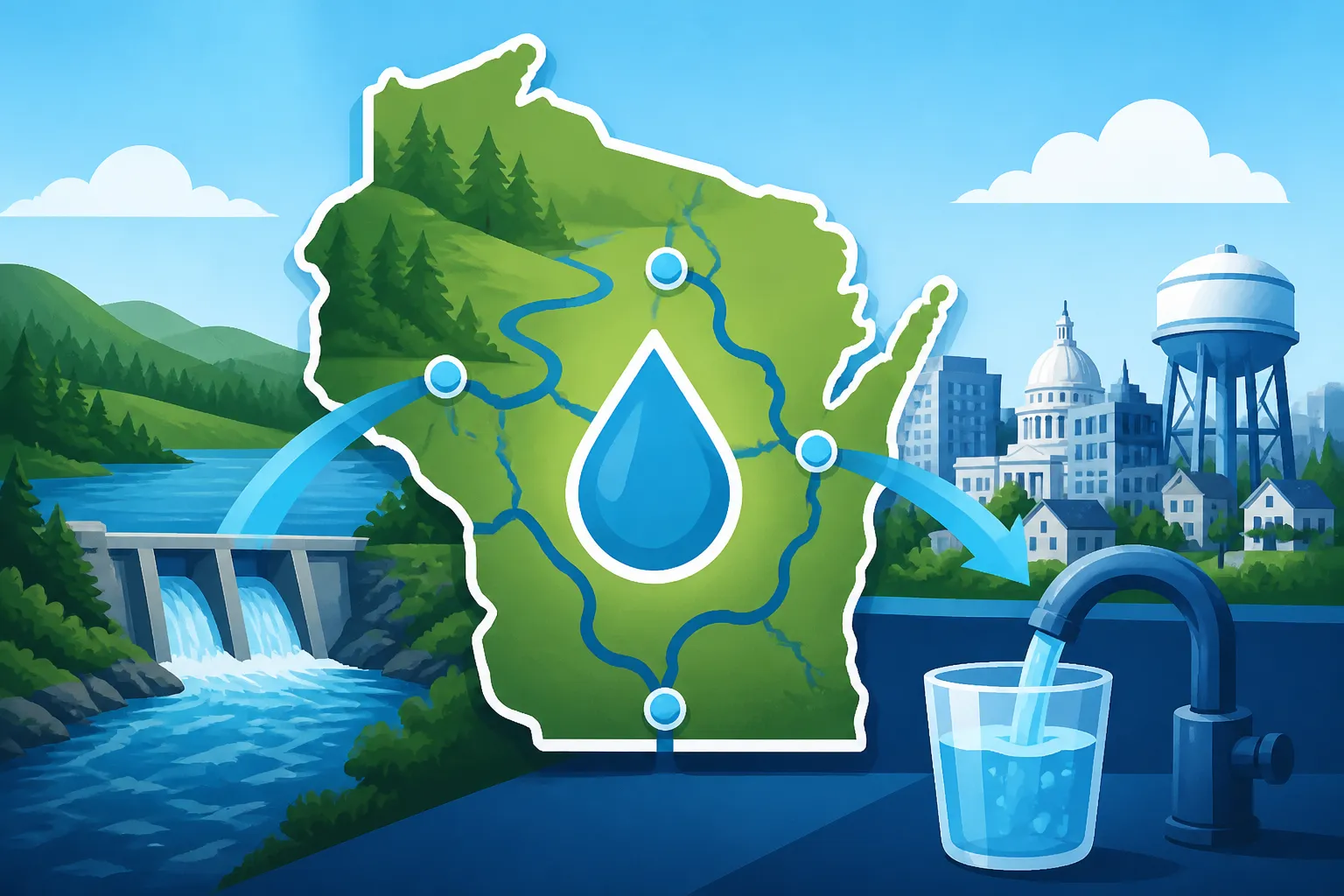
A city’s drinking water source is shaped by local geography, available infrastructure, water demand, and the way a utility manages its supply. Some systems pump groundwater from wells. Others take water from a lake or river, then treat it before sending it through the distribution system. A utility may also use more than one source, either to serve different parts of its service area or to manage supply over time.
The name of a city is not always enough to tell you where the water at a particular address comes from. A utility may operate several wells or draw from different sources, and a city boundary does not necessarily match the boundary of the water system. A home near the edge of town might be supplied by a neighboring system, while addresses within one utility’s service area may be served by different wells or source zones.
That is why broad statements such as “the city gets its water from a lake” can leave out useful detail. They may refer to a major source without describing other sources, changes in which wells are operating, or how the water gets from the source to a particular neighborhood.
| Source type | What it means | What to look for in a report |
|---|---|---|
| Groundwater | Water is pumped from underground through wells. | The wells or groundwater source listed, and any source-specific monitoring information. |
| Surface water | Water is drawn from a lake, river, or another surface source. | The named source, treatment information, and any reported monitoring findings. |
| Multiple sources | A system uses more than one source or supply area. | Whether the report describes different sources, wells, or service zones. |
| Purchased or shared supply | A utility receives treated water from another system or works with another provider. | The supplying system and the source information it provides. |
For more background on source types, see Deep Aquifers vs Great Lakes: Wisconsin Municipal Tap Water Sources and Where Does Your City Water Come From in Wisconsin?. These explain the broad distinction, but your own utility’s report is the place to check what applies to your address.
It also helps to separate the source from the treatment plant and the pipes. The source is where the raw water originates. Treatment describes how the utility prepares that water for delivery. The distribution system carries treated water to customers. A change in appearance or taste at a faucet does not, by itself, identify which source supplied the water or whether the source has changed.
Groundwater: wells and aquifers
Groundwater is water held beneath the ground in spaces within soil and rock. A municipal well draws from an underground water-bearing formation, often called an aquifer. The well pumps that water toward the treatment and distribution system, where the utility manages it for public supply.
For a customer, the important point is that “groundwater” is a broad description, not a complete source profile. Different wells can draw from different underground formations or depths, and water from one well can have different characteristics from water drawn from another. The details depend on local geology and on how the utility operates its wells.
Groundwater can contain naturally occurring minerals or other substances picked up as water moves through underground materials. That does not mean every groundwater source has the same composition, or that a particular mineral is automatically a safety concern. Taste, hardness, staining, and other noticeable features can be related to source characteristics, treatment, household plumbing, or more than one of these factors. Appearance and taste are not substitutes for a test result or a utility report.
A system may operate several wells and use them in different ways. It may draw from one well, several wells, or a changing combination. Customers usually cannot determine which well supplied a tap by looking at the water. If the utility has well maps, source-area information, or a well lookup tool, those may help connect a service address to a supply area. Availability varies, so ask the utility what information it provides.
The source information in a report may use well names, numbers, or other identifiers that are not familiar to customers. These labels identify parts of the utility’s supply, but they do not always tell a reader how water moves through the neighborhood or whether a particular well was operating at a particular moment. If the report lists several wells, read the explanatory text around the list and ask the utility how the wells are used.
Groundwater sources may be treated before delivery. The treatment approach depends on the source water and the system’s design. A report can describe the general treatment process, but a short summary may not provide detailed operating information for every well or treatment step. For a broader look at how cities identify wells and service areas, see How to Find Which City Well Serves Your Tap in Wisconsin and How Municipal Well Zones Affect Your Home Tap Water.
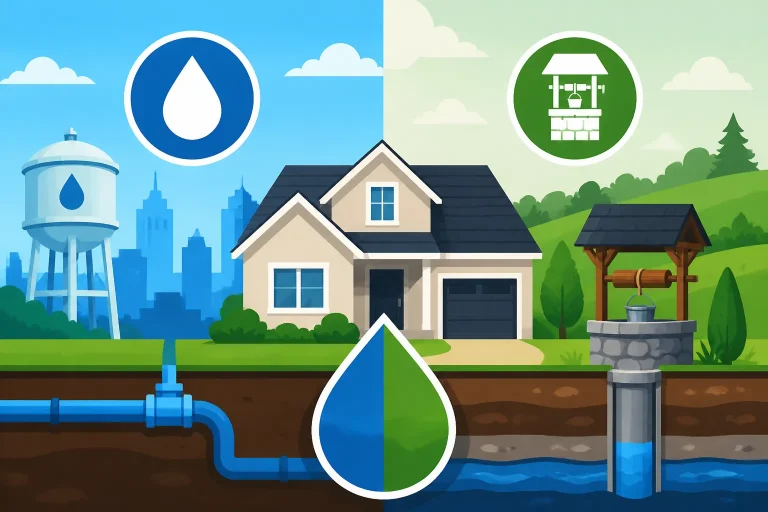
Do not assume that groundwater means untreated water, or that a well serving a city is the same as a private household well. Municipal systems and private wells have different owners, operating arrangements, and reporting contexts. A city customer should use the public water system’s report and utility information rather than infer the condition of the municipal supply from a nearby private well.
Surface water: lakes and rivers
Surface water comes from a lake, river, or another water body at the land surface. A utility that uses surface water collects it through an intake and treats it before sending it to customers. The source may be familiar by name, but the water still has to be understood as part of a managed supply system: source, treatment, storage, and distribution all matter.
Surface water can vary with natural conditions and activity in the surrounding watershed. A watershed is the area from which water drains toward a lake or river. Rainfall, runoff, seasonal conditions, and other influences can affect the raw water that reaches an intake. These changes do not necessarily mean treated tap water is unsafe; utilities monitor and manage their supplies. Customers should use the utility’s current notices and report rather than try to judge treatment performance from a visible change in a lake or river.
Treatment is a key part of understanding a surface-water supply. The utility selects and operates treatment processes based on its source and system needs. A report may describe the source and general treatment, while its contaminant information summarizes what was tested and detected under the system’s monitoring program. It is not a real-time readout of every change in raw water or every treatment operation.
The utility’s source and its treatment plant are related, but they are not interchangeable terms. A city may draw raw water from one named source and process it at a treatment facility before distribution. Knowing the name of the lake or river alone does not tell you which treatment steps are used, how the treated water is stored, or which neighborhoods receive it.
Surface-water systems can also rely on more than one source or work with another utility. When a report lists multiple sources, look for an explanation of whether the sources are used together, separately, or under particular operating conditions. If it is not clear, ask the utility rather than assuming that one source supplies every tap all the time.
For a customer concerned about a specific lake or river, a useful first step is to distinguish information about the natural water body from information about finished tap water. Environmental monitoring of a lake, river, or watershed may address the broader ecosystem; a drinking-water report focuses on the public system’s source and regulated drinking-water monitoring. These records can answer different questions.
The Wisconsin Consumer Confidence Reports: A Tap Water Guide explains how to use an annual report to understand source information and monitoring findings. If you want to see how source details fit into a specific utility’s report, use the utility’s own current report and confirm that it covers your service area.
When a city uses multiple sources or another system’s water
A municipal water supply is not always a single well or a single intake. Some utilities manage several sources, and a system’s operating mix may depend on its infrastructure and supply needs. A report may identify multiple wells or surface sources without spelling out which one is supplying a particular street at a given time.
A utility may also receive water from another public water system. In that situation, the customer’s local utility may manage billing and distribution even though another provider treats the water or supplies it at a connection point. The terms used in reports can differ, so check which organization is described as the source, which one treats the water, and which one is responsible for the service connection.
When multiple systems are involved, there may be more than one report worth reviewing. Your direct provider is the best place to begin because it can explain how the supply reaches your address and which report applies. If the provider says that water is purchased from or supplied by another system, ask whether the other system’s report contains additional source or treatment detail.
A blended supply can complicate simple comparisons. For example, the overall water delivered may reflect more than one source, and the mix can vary. A single sample or a single line in a report may not tell you which source contributed most to the water at a specific faucet at a particular time. Do not infer a source change from a taste difference alone.
Use these questions to clarify a report that lists multiple sources:
- Does the utility use all listed sources, or are some available only as backup?
- Do different wells or sources serve different areas?
- Does the source mix change during normal operation?
- Is water purchased from another system?
- Which report should a customer at this address read?
- Can the utility identify a well zone or supply area for the address?
A utility may not have a simple public lookup that answers every question. It may still be able to explain the system’s general arrangement or direct customers to a map or report. The purpose of asking is not to demand a minute-by-minute source history, but to understand which system and report are relevant.
This distinction matters when neighbors compare water. Two homes in the same city can have different providers, service zones, plumbing, or building-level equipment. Even homes served by the same utility may not receive water from the same well or source at every moment. A neighbor’s report or experience can offer context, but it does not replace checking the source information for your own service.
What treatment and delivery mean for your tap
The source is only one part of the path to a faucet. After collection, public water may pass through treatment, storage, and a distribution network before reaching a building. Inside the building, water then travels through customer-side plumbing and fixtures. Each part can influence what a customer sees or experiences, so it is useful to keep the pieces separate.
Treatment is designed around the raw water and the system’s needs. The method used for groundwater may differ from the method used for surface water, and treatment can vary between systems. A report may give a general description, but it is not necessarily an engineering document or a complete operating log. If you need details about a specific treatment step, ask the utility what it can provide.
Distribution includes pipes and other infrastructure that move treated water through streets and into service connections. A utility’s source report does not automatically explain every condition in that network. For example, a temporary change in pressure or a water main repair is a distribution issue, while the identity of the original source is a separate question. See How Wisconsin Water Systems Manage Pressure Loss and Main Breaks for more on how distribution events differ from source information.
The customer’s side of the plumbing can matter too. Building pipes, faucets, and fixtures may affect water quality at the point of use. If your concern is about a specific household tap rather than the utility’s general supply, the right next step may be different from reading a source description. For instance, questions about lead should be assessed with the relevant utility information and, when appropriate, a sample from the tap. Customer Side vs Utility Side Pipes in Wisconsin Municipal Systems explains why the division between public and private plumbing matters.
A report’s results do not necessarily describe every individual faucet. Utility monitoring provides information about the public system under its sampling and reporting requirements. A household test addresses water at a chosen location and time. The two kinds of information answer related but distinct questions, as discussed in Understanding Differences Between City CCR Data and Faucet Tests.
A few practical distinctions help prevent confusion:
- Raw source water is water before the utility’s treatment.
- Treated water is water after the utility’s treatment process.
- Distributed water is treated water moving through the public network.
- Tap water is water at the fixture, after it may have passed through building plumbing.
- A household test is a sample collected from a particular faucet under particular conditions.
If water changes suddenly in color, odor, or taste, do not assume that the source has changed or that the utility’s annual report explains the change. Check for a current utility notice and contact the provider through its official website if the condition persists or raises a concern. A report is useful for understanding the system’s routine source and monitoring information; a current utility notice is more appropriate for a current incident.
How to find the source for your address
Start with the provider named on your water bill or rental documents. A city name on a mailing address does not prove that the city utility supplies the property. The property may be served by another public system, or, in some locations, by a private well. If you are unsure, confirm the provider with the property owner, manager, utility, or the official water-system lookup information available for your area.
Then find the utility’s consumer confidence report, also called a water quality report or annual water quality report. According to the Wisconsin Department of Health Services, a consumer confidence report describes “where the drinking water comes from, what contaminants are detected and their potential health effects, and if there are any standards violations”. The report is a strong starting point for understanding a community system, but it may not answer every address-specific question.
Use this process:
- Confirm the water provider. Check a recent bill, account record, or property information. If you rent, ask the landlord or property manager which utility serves the building.
- Find the report that matches the provider. Check the report’s system name and service-area description rather than relying only on a city name.
- Read the source section. Look for groundwater wells, surface-water sources, purchased water, or a description of multiple sources.
- Check whether the report covers the whole service area. If it discusses separate zones or systems, note whether your address is included.
- Review the treatment description. This can clarify what happens between the source and the distribution network.
- Use the report’s contact information carefully. For current details, find the utility’s official website and use the contact method listed there.
- Ask a focused follow-up question. If the source list is unclear, ask which source or service zone applies to your address and whether the utility can identify a well or supply area.
A report may not list an individual household’s source in a way that can be matched directly to a street address. That does not mean the information is unavailable; it may require a question to the utility, or the system may not track source delivery at that level. Avoid treating a general city map or a neighbor’s answer as proof of your own supply.
If you are comparing reports, check the system name and reporting period, and make sure the documents cover the same provider or service area. A report from a nearby city may describe a different system even if the water sources are geographically close. Likewise, a report for a parent utility may not provide all the detail for a small area served through a separate arrangement.
For help locating records, see How to Look Up Your Town on the Wisconsin Drinking Water Portal and Wisconsin Consumer Confidence Reports: A Tap Water Guide. These resources can help you navigate public system information, but if you need an address-specific answer, confirm it with the utility.
How to read source and contaminant information without overreading it
A water quality report is a summary of a public water system’s source, monitoring, and reported results. It is useful, but the entries need context. A detected substance does not automatically mean a violation, and a report that does not list a detection does not mean the system never has any variation. Pay attention to the report’s definitions, units, sampling context, and explanatory notes.
Start by identifying what a line in the report refers to. It may describe a source, a contaminant, a monitoring result, a standard, or a treatment process. These are not interchangeable. A source description tells you where water comes from; a detection result tells you what was found in a sample under the reported monitoring; and a standards entry addresses compliance with the applicable requirements described by the report.
Read the report’s notes alongside its table. A table may use abbreviations or technical terms, and the accompanying text may explain what was tested, how results are presented, and what a result means. If you cannot tell whether a result is associated with raw source water or finished drinking water, ask the utility to clarify. Do not assume a result applies to every source or every tap.
The source section and the contaminant section should be read together, but neither replaces the other. Knowing that water comes from a well or lake does not establish what was detected. Likewise, seeing a reported detection does not tell you the source unless the report connects that result to one. A report’s potential health effects and standards information can help frame the result, while the utility can clarify how it applies to the system.
Keep these limits in mind:
- An annual report is not a live display of current operating conditions.
- A system-wide report may not describe a sample from your own faucet.
- A named source may not be the only source used by the system.
- A listed detection needs to be interpreted with the report’s definitions and standards context.
- A taste, odor, or color observation cannot identify a contaminant or establish a source.
- A private household test does not automatically characterize the entire municipal system.
If your question is about a detected substance, consult the report’s explanation and contact the utility for system-specific context. For a health question about a possible exposure or an individual’s circumstances, ask a local health department or medical professional. If you are considering a filter, first identify what you want it to reduce and compare the product’s certification with relevant test results; no general filter claim should be assumed to apply to every contaminant.
For more help interpreting report entries, see Understanding Detected Contaminants on Your Wisconsin Water Report and Annual Water Quality Reports: Reviewing Potential Health Effects. The most useful reading is specific: match the report to the correct provider, distinguish source information from test results, and ask the utility to explain anything that is not clear.
Frequently Asked Questions
Does every Wisconsin city use groundwater?
No. Public systems can use groundwater, surface water, multiple sources, or water supplied by another system. Check the report for the utility that serves the address rather than assuming that every city uses the same source type.
Can I tell which city well supplies my tap?
Not from the water’s taste, color, or appearance. Some utilities provide well or service-area information, but an address-level lookup may not be available. Ask the utility whether it can identify the relevant well or supply zone.
Does a consumer confidence report tell me exactly what is in my faucet?
It describes the public system’s source and reported monitoring information, but it is not necessarily a test of your individual faucet. Building plumbing and the particular sample location can matter. If your concern is specific to a household tap, ask the utility or a qualified professional what testing makes sense.
What should I do if the report lists more than one source?
Check whether the report explains how the sources are used and which areas they serve. If it does not answer your question, ask the utility which source or service zone applies to your address and whether another system supplies part of the water.
Sources
- Wisconsin Department of Health Services — Drinking Water: Public Water Systems | Wisconsin Department of Health Services (checked November 13, 2026)
Disclaimer
This article is for general informational purposes only and does not constitute professional advice. Laws, prices and regulations vary by location and change over time. Consult a qualified professional for guidance on your specific situation. Wisconsin Water Guide is not a government agency or water utility and is not affiliated with any public water system.