Reading the Annual Milwaukee Water Works Water Quality Report
Milwaukee’s annual water report can look like a wall of testing terms, units, and regulatory language. The useful question is not just whether a substance appears, but what the result measures, how it compares with the stated standard, and whether it describes utility-wide water or your own faucet. Here’s how to read the report without drawing conclusions it cannot support.
Start with the report’s scope and reporting period
Milwaukee Water Works says: Each year, public water systems must publish a Water Quality Report. Milwaukee Water Works says the 2025 Water Quality Report includes Milwaukee water quality testing results. Those details make the report an important source for understanding the system’s results, but they do not mean every result is a test of water collected from your home.
Start by checking the report’s title, reporting period, and description of the water system it covers. A report title may identify the year it was published, while its tables may describe testing conducted during a stated reporting period. Read the report’s own explanation rather than assuming that the title year and the testing period are identical.
Next, check the service-area description. If you live in Milwaukee or receive a bill from Milwaukee Water Works, the report is a sensible place to begin. If your home is outside the system’s service area, find out which utility serves the address before relying on Milwaukee’s results. City boundaries, mailing addresses, and water-service boundaries do not always match. For help identifying the source that serves a particular home, see How to Find Which City Well Serves Your Tap in Wisconsin and Where Wisconsin Cities Get Drinking Water: Full Overview.
A report usually describes water across a public system rather than a sample from every home. Its results can help you understand what the utility measured and how it compares with the standards and explanations provided in the report. They do not automatically describe what happens inside a particular building’s plumbing, or establish the result at a faucet that was never sampled.
Look for the report’s introductory explanation of how results should be read. It may define terms, explain why a contaminant is included, or clarify whether a table presents detected substances, monitoring information, or compliance findings. That explanation matters because the same word can carry different implications depending on the table and the context.
If you are trying to locate the report itself, Where to Get a Copy of the Latest Milwaukee Water Quality Report focuses on finding the current document. For help understanding annual reports in general, Wisconsin Consumer Confidence Reports: A Tap Water Guide offers broader context.
Read the tables without confusing detection with risk
The tables often take the most effort to interpret. Before focusing on a result, identify the substance, the unit, the type of measurement, and the column heading. Then look for the report’s explanation of how the result relates to a limit or other benchmark. A result cannot be interpreted reliably by scanning just one number or label.
| What to check | What it can tell you | What not to assume |
|---|---|---|
| Substance or contaminant name | What the utility tested or reported | That every listed substance was detected |
| Result and unit | How the measured amount is expressed | That values in different units can be compared directly |
| Detection language | Whether a result was reported above a stated reporting threshold | That any detection automatically means a health concern |
| Standard or benchmark | The comparison the report uses | That every benchmark has the same purpose |
| Footnotes | How to interpret the table, sampling, or result | That the table heading tells the whole story |
| Health explanation | What context the report gives for the substance | That a general explanation is personal medical advice |
Read the column headings before comparing results. A table may separate the highest result, a range, an average, or another summary. Those terms describe different things. A result at the top of a reported range does not necessarily mean every customer received water with that result, just as an average does not describe every sample. Use the report’s own definitions to understand what a summary represents.
Pay close attention to units. A result expressed in one unit cannot be compared casually with a result expressed in another. If a report provides a standard and a measured value, check that the units match and that the comparison uses the same substance and measurement basis. If the report does not make the relationship clear, consult its definitions or ask Milwaukee Water Works for clarification.
A detection is not the same as a conclusion about risk. Detection means a substance was measured or reported under the method and threshold described by the report. The meaning of that detection depends on the amount, the relevant standard or benchmark, how the sample was collected, and the context given in the report. A detected result may be below a stated limit; a result shown as not detected does not necessarily mean the substance is absent at every possible concentration. Look for an explanation of reporting limits and detection terminology before treating either phrase as a complete answer.
Also distinguish a regulatory limit from a health goal, advisory, or other comparison value. These terms can serve different purposes. A report’s explanation should make clear which kind of value appears in the table and how the utility uses it. Do not treat two different benchmarks as interchangeable simply because both appear near a contaminant result.
Footnotes are part of the data, not optional fine print. They may explain whether a result is based on monitoring over time, what sampling location was used, or why a result appears in a particular format. A symbol or abbreviation may also refer to a definition elsewhere in the report. If a result seems surprising, trace it to the relevant footnote and the report’s glossary before deciding what it means.
For a closer look at the language used in contaminant tables, read Understanding Detected Contaminants on Your Wisconsin Water Report. If the report uses unfamiliar laboratory terms, Understanding Differences Between City CCR Data and Faucet Tests can help clarify why utility-wide data and a household sample answer different questions.
Understand compliance, health notes, and treatment
A compliance statement answers a specific question about the public water system and the requirements described in the report. It is useful, but it does not tell you everything about the water at every faucet or every possible household concern. Read the statement alongside the relevant table, the period it covers, and any notices or explanations that accompany it.
A report may include several kinds of information: testing results, a comparison with a standard, an explanation of a detected substance, and a summary of the system’s compliance status. Those pieces complement each other, but they are not interchangeable. A table entry is not necessarily a notice that an immediate action is needed, and a general statement about compliance should not be used to dismiss a concern that the report does not address.
When a report discusses health effects, treat the wording as general context about the substance, not a personalized assessment. People can have different circumstances, and a utility report is not a medical evaluation. For questions about a possible health effect or a specific person’s exposure, ask a medical professional or the local health department.
It also helps to identify what the report says about treatment. Public water systems may describe treatment or monitoring as part of explaining how water quality is managed. A treatment description provides context about the system; it does not establish that a household filter is necessary, or that a particular product will address a specific result. If you are considering a filter, match its certified reduction claims to a relevant water test and check that the certification covers the substance and use you care about. A filter should not be treated as a substitute for understanding an official notice or getting appropriate advice.
For fluoride questions, distinguish the system’s monitoring information from a result at a specific faucet. How to Check Fluoride Levels in Your Wisconsin Tap Water explains how to approach that question. If you are reading about lead, remember that a utility-wide report and testing at an individual home can answer different questions; Lead and Copper Protection in Wisconsin Municipal Tap Water provides related context.
Avoid reading a health note as a prediction that a particular person will experience an effect. The report may explain why a substance is monitored or why a benchmark exists, but it cannot account for every person’s health, plumbing, water use, or exposure from other sources. If you need health guidance, consult a medical professional or the local health department.
Connect utility-wide results to your own tap
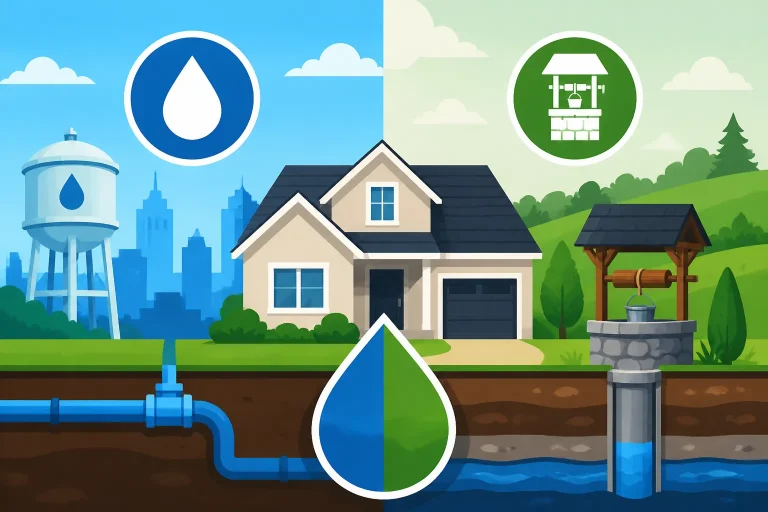
A public water report describes the water system’s testing, not the complete condition of every building’s plumbing. Water can travel through pipes and fixtures after it leaves the utility system. Materials in a building’s service line, interior plumbing, and fixtures can affect a sample collected at a tap. That is why a utility result and a home faucet test should not be treated as competing versions of the same measurement.
Lead is a clear example of why the distinction matters. A system report can provide useful information about utility monitoring and the broader supply, while a home-specific concern may require attention to the service line, plumbing, or a sample taken from a particular faucet. If you are concerned about a lead service line, review Customer Side vs Utility Side Pipes in Wisconsin Municipal Systems and How to Find Out if Your Wisconsin Home Has a Lead Line. A report alone may not identify the materials or condition of every pipe serving your home.
A home test can answer a more localized question, but only if the sample is collected and analyzed appropriately. The relevant sample location, water-use conditions, and laboratory method depend on what you are trying to find out. Before ordering a test, define the question: are you checking a utility-reported substance, investigating building plumbing, or responding to a taste, odor, or appearance change? The answer helps determine whether you need a utility report, a household sample, or direct guidance from the utility or a qualified professional.
Taste, smell, and color are not reliable substitutes for laboratory results. A change may have several possible explanations, and appearance alone does not identify a contaminant. If water changes suddenly or you receive a utility notice, follow the instructions from Milwaukee Water Works rather than relying on the annual report to resolve a current event. For changes in appearance, Managing Discolored Tap Water After City Hydrant Flushing Work may help explain one possible utility-related situation. For a new taste or odor, see Reporting Unusual Tap Water Taste or Odor to Your Utility Provider.
The report is best used as a starting point: it tells you what Milwaukee Water Works reports about system testing and how the results are presented. If your question is about a particular home, match the report to the address and water provider, then decide whether a home-specific inspection or test is needed. If your question is about a current advisory or interruption, use the utility’s current notice rather than assuming the annual report describes conditions now.
A practical way to work through the report
Instead of trying to understand every table at once, read with a specific question in mind. The following approach keeps the task manageable and helps prevent a result from being taken out of context.
- Confirm the system and reporting period. Check that the report covers the water provider serving your address. Read the report’s own description of the period represented by the results.
- Read the introductory notes. Find the definitions for detection, units, standards, and any symbols or abbreviations used in tables.
- Locate the relevant substance or topic. Search the report for the contaminant, treatment process, or monitoring question you have. Do not assume that a substance is absent simply because it is not prominent in the summary.
- Read the full row and its notes. Review the result, unit, comparison value, and associated footnotes together. Check whether the entry is a measurement, a summary, or explanatory information.
- Separate system results from home conditions. Consider whether the concern relates to utility-wide water quality or to a service line, plumbing, or faucet in a particular building.
- Follow current instructions for urgent concerns. If a current notice applies, use its directions. The annual report is not a substitute for an active utility notice.
- Ask for clarification where the report leaves a gap. Contact Milwaukee Water Works for questions about its results or reporting language. For health questions, contact a medical professional or local health department.
This approach also helps when comparing reports. Compare the same substance, units, type of result, and reporting context. A difference between reports may reflect different sampling periods, reporting formats, or measurement approaches rather than a direct change in the water. Avoid drawing a trend from values that are not directly comparable.
If you are unsure whether a result relates to a specific health concern, do not rely on a product label or a broad internet summary to interpret it. Start with the report’s definitions and contact the appropriate professional for the question you have. For a home treatment decision, test results and a product’s certified claims need to match. For a concern about a current water condition, use the utility’s current communications.
Frequently Asked Questions
Does the report describe the water from my kitchen faucet?
Not necessarily. The report presents Milwaukee Water Works testing results for the public system. It does not automatically represent a sample from your home’s faucet or account for the building’s plumbing. For a home-specific question, determine whether a separate inspection or test is appropriate.
Does a detected substance mean the water is unsafe?
Not by itself. Check the reported amount, unit, applicable standard or benchmark, and the report’s explanation. A detection is a measurement, not a complete health assessment. For a health question, ask a medical professional or local health department.
What should I do if a table’s result is unclear?
Read the headings, definitions, and footnotes together. Confirm that the result and comparison value use the same units, and note whether the table is describing a measurement or a summary. If the report still does not answer your question, contact Milwaukee Water Works for clarification.
Is an annual report the right place to check for a current water notice?
Use the utility’s current communications for a current advisory or interruption. An annual report summarizes testing information and may not describe a developing condition or a notice issued after the reporting period.
Should I buy a filter because the report lists a contaminant?
Not based on the listing alone. Confirm what the result means, whether it applies to your concern, and whether a product is certified to reduce that specific substance. A filter’s claims should be checked against relevant test results, and it should not replace instructions from the utility or professional advice.
Disclaimer
This article is for general informational purposes only and does not constitute professional advice. Laws, prices and regulations vary by location and change over time. Consult a qualified professional for guidance on your specific situation. Wisconsin Water Guide is not a government agency or water utility and is not affiliated with any public water system.